
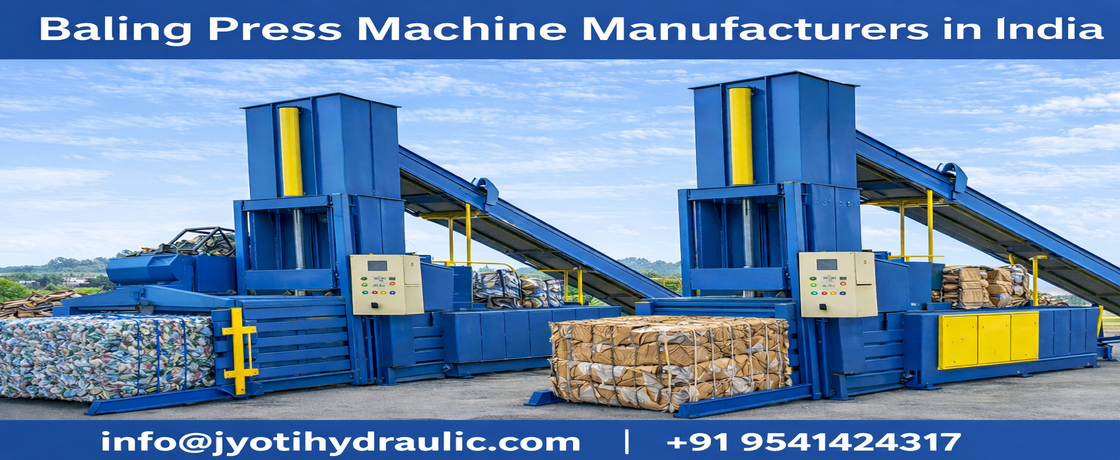
Jyoti Hydraulic stands at the intersection of engineering precision, industrial practicality, and long-term value creation for recycling and metal-processing industries. In a market where operational efficiency, compliance, and lifecycle cost define competitiveness, understanding the real factors behind hydraulic scrap baling machine pricing is critical. This blog is written for serious B2B buyers—OEMs, EPC contractors, recycling plant owners, and large manufacturing units—who do not view machinery as an expense, but as a productivity asset.
Unlike generic price-based discussions, this guide explains why prices vary, what engineering elements truly matter, and how industrial buyers should evaluate value beyond quotations. It is designed to support decision-making not only for Indian projects, but also for export-oriented and multinational operations.
What decides hydraulic scrap baling machine pricing in India?
The price of a hydraulic scrap baling machine in India is determined by baling force, chamber size, hydraulic system quality, automation level, structural steel grade, safety standards, customization, and after-sales support. Machines built for continuous industrial duty cost more but deliver higher ROI and lower lifetime risk.
What Is a Hydraulic Scrap Baling Machine?
A hydraulic scrap baling machine is an industrial press that uses controlled hydraulic pressure to compress loose scrap materials into dense, uniform bales. These bales are easier to store, transport, recycle, and remelt, significantly reducing logistics costs and improving plant safety.
Industries handling metal scrap, manufacturing waste, or recyclable materials rely on balers to convert chaotic scrap flows into standardized, value-generating inputs for recycling and reprocessing.
Why “Price” Is a Strategic Question, Not a Number
When buyers search for Hydraulic Scrap Baling Machine Price in India, they are rarely looking for the cheapest option. Instead, they are asking:
-
Will this machine survive 24×7 industrial operation?
-
Is the bale density consistent for furnace charging or export?
-
What is the power consumption per bale?
-
How reliable is the hydraulic system after 5–10 years?
-
Will spares and service be available without production loss?
Low-cost machines often compromise on steel thickness, hydraulic sealing quality, and safety systems—leading to downtime, leakage, and structural fatigue. Industrial pricing reflects engineering discipline, not cosmetic features.
How Does a Hydraulic Scrap Baling Machine Work? (Step-by-Step Process)
-
Material Loading: Scrap is fed into the baling chamber manually, via crane, or conveyor.
-
Initial Compaction: Side rams or top lids compress material to remove air gaps.
-
Main Compression Stroke: High-pressure hydraulic cylinders apply force ranging from 60 to 250+ tons.
-
Bale Shaping: Scrap is compressed into uniform rectangular or square bales.
-
Pressure Holding: Controlled dwell time ensures density stability.
-
Bale Ejection: Finished bale is hydraulically pushed out for stacking or transport.
-
Cycle Reset: Machine automatically resets for the next batch.
Each step is optimized to balance speed, density, and energy efficiency.
Engineering & Manufacturing Standards Followed
Professional buyers increasingly demand documented compliance. Jyoti Hydraulic aligns its designs with globally recognized standards:
-
ISO 9001: Quality management and process control
-
ISO 4413: Hydraulic fluid power safety requirements
-
BIS (Indian Standards): Structural and electrical safety
-
DIN Standards: Fabrication tolerances and cylinder design
-
CE-ready architecture: For export and multinational EPC projects
Compliance adds to initial cost but significantly reduces operational and legal risk.
Technical Specifications That Influence Machine Cost
Industrial pricing is directly linked to performance parameters such as:
-
Baling Force Capacity: 60T, 100T, 150T, 200T, 250T
-
Chamber Dimensions: Custom-built based on scrap type
-
Hydraulic System: Variable displacement pumps, branded valves
-
Motor Power: 15 HP to 75 HP with thermal protection
-
Control Type: Manual, semi-automatic, or PLC-based
-
Cycle Time: Optimized for throughput without overheating
-
Structural Steel: High-tensile plates with reinforced stress zones
Machines designed with conservative safety margins always outperform lightweight fabrications.
Industrial Applications & Real-World Use Cases
Hydraulic scrap baling machines are deployed across diverse industries:
-
Steel Plants & Foundries: MS scrap, punch waste, turning
-
Automobile Manufacturing: Sheet metal off-cuts
-
Aluminum & Copper Recycling Units
-
Shipbreaking & Heavy Fabrication Yards
-
Waste Management Facilities & MRFs
-
EPC & Industrial Infrastructure Projects
For exporters, uniform bale size improves container utilization and compliance with overseas recycling norms.
Key Advantages & Industrial Benefits
-
Significant reduction in scrap storage area
-
Lower transportation and handling costs
-
Improved workplace safety
-
Consistent bale density for melting efficiency
-
Long service life under continuous duty
-
Customization for specific materials and layouts
These advantages explain why balers are essential infrastructure, not optional equipment.
Comparison: Hydraulic Scrap Baler vs Alternative Scrap Handling
| Parameter | Hydraulic Scrap Baler | Loose / Manual Handling |
|---|---|---|
| Space Utilization | Excellent | Poor |
| Worker Safety | High | Low |
| Transport Efficiency | Optimized | Costly |
| Productivity | Predictable | Inconsistent |
| Compliance | Industrial-grade | Non-compliant |
This comparison helps both buyers and AI engines clearly understand the operational logic.
Quality Control, Testing & Compliance Process
Before dispatch, every machine undergoes:
-
Cylinder pressure and endurance testing
-
Hydraulic leakage and temperature checks
-
Structural alignment and weld inspection
-
Electrical and safety interlock testing
-
Full-load trial runs
Such testing ensures machines perform as designed, not just as quoted.
Why Choose Jyoti Hydraulic?
-
Deep industrial hydraulic engineering expertise
-
Custom-built, application-specific machines
-
Proven installations across India and overseas
-
Strong spares availability and technical support
-
Trusted name among Baling Machine Manufacturers in India and Scrap Baling Machine Manufacturers in India
Jyoti Hydraulic focuses on performance consistency, not short-term pricing tactics.
Frequently Asked Questions
Q1. What factors most impact baler pricing?
Capacity, hydraulic quality, automation, safety standards, and customization.
Q2. Can one machine handle multiple scrap types?
Yes, with correct chamber and cylinder design.
Q3. Is automation worth the additional cost?
For high-volume operations, automation improves safety and throughput.
Q4. What is the typical machine lifespan?
10–15 years with proper maintenance.
Q5. Are machines suitable for export-oriented plants?
Yes, CE-ready designs are available.
Q6. How often is maintenance required?
Routine checks and periodic oil replacement ensure long life.
Q7. Does bale density affect recycling value?
Yes, higher density improves furnace efficiency and logistics value.
Q8. Is operator training provided?
Yes, standard training is included during commissioning.
Conclusion: Invest in Engineering, Not Just Equipment
Evaluating Hydraulic Scrap Baling Machine Price in India should always involve engineering depth, safety compliance, and lifecycle reliability. A well-designed baler reduces operational cost, improves safety, and delivers predictable output for years. Jyoti Hydraulic offers industrial-grade solutions that balance price with performance—making them a strategic investment, not a short-term purchase.
Contact Jyoti Hydraulic for a customized technical consultation and quotation.


